MOTOROLA
POLICE MOTORCYCLE RADIO INDEX
1947-1992
PART ONE, 1947-1958
INTRODUCTION: This page is a summary of motorcycle radios made by Motorola, Inc. up to approximately 1992. In many cases, particularly with the later model radios, the dates of manufacture are approximate since Motorola did not publish summaries of this information and it is necessary to scavenge date information from manuals, and dates stamped on examples of the equipment itself. It is a work in progress where changes and corrections will be regularly made.
There are probably many models not shown here, mainly the special production sets made for large customers. The California Highway Patrol 1977 radios would be one example (covered in my CHP Radio pages.) The radios shown here are the "off the shelf" regular models shown in the standard Buyers Guides and sales literature. If you have photos of sets not shown here, please share them and I will add them to the page.
Motorola was somewhat of a late starter in police radio, not manufacturing an actual police radio receiver until 1937. As far as can be determined, Motorola's first police motorcycle radio was not made until the late 1940's, and was the two-piece FMTRU-5V "Dispatcher" series set of 1947. During the 1930's and until 1947, police agencies used RCA, GE, Comco, Air Associates, Link Radio (Vetric) and a variety of home-made radios. Prior to 1946, virtually all commercially made police motorcycle radios were one-way "receive only" sets. Please note that Motorola was not the main manufacturer of police radios until well after WWII, but became the predominant police radio make in the 1950's, including motorcycle sets.
Motorcycle radios are more rare than the automobile version; after WWII, there were perhaps 100 cars for every motorcycle in a police force, hence the difference. By way of definition, throughout this page, "Solocycle" refers to a 2-wheel motorcycle while "Servicar" refers to a 3-wheeled cycle with utility box.
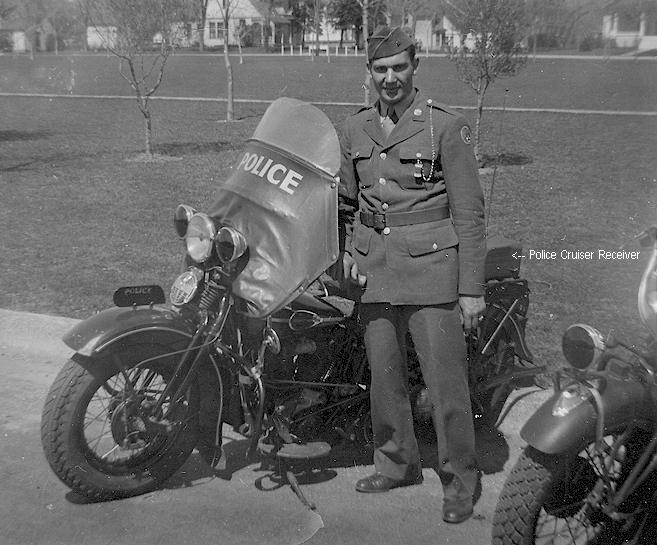
The photo below, believed to date from approximately 1945, shows an early attempt to make a motorcycle radio from a car radio, before Motorola actually sold such a product. This is a Motorola "Police Cruiser" automobile type medium frequency one-way receiver mounted on its back on the rear of a motorcycle, with a car radio antenna installed on the housing front (now top) cover. This installation could hardly have been very reliable, since it is expected that vibration would have caused the tubes to leave their sockets and the adjustments to quickly go awry. It would also not have been even slightly weatherproof.
Photo courtesy of Scott Cacciamani, Staten
Island, NY
DISPATCHER Series (1947-53)
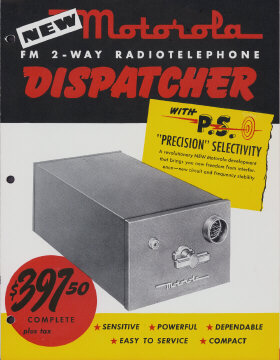
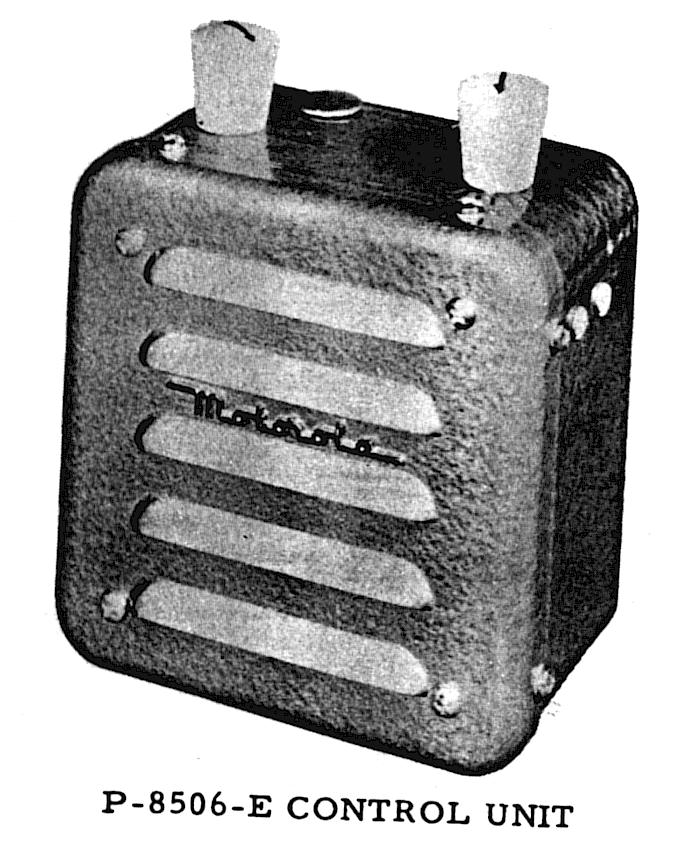
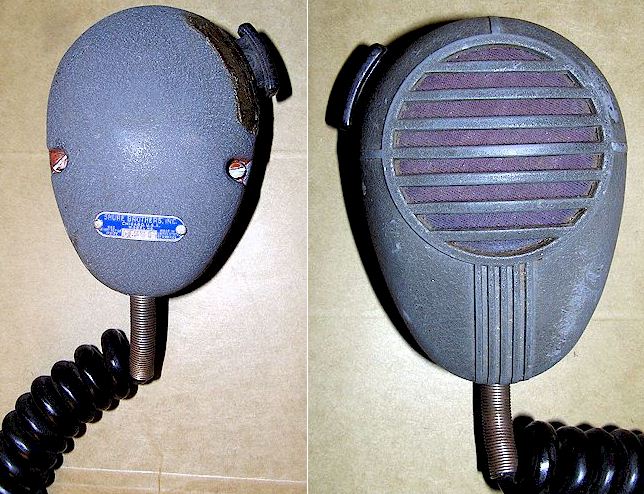
Motorola's first one-piece car type FM two way radio was the "Dispatcher" model, introduced in 1947 as an "economy" radio, manufactured through approximately 1952. This model was also offered in a motorcycle version, accomplished by separating the internal chassis units so that the transmitter and power supply chassis was on one side of the rear wheel in its own box, and the receiver was on the other side. The appearance is exactly like that shown below for the "Research" radios. This was a 6 Volt vibrator powered radio with a 10 Watt transmitter. The "Solocycle" control head consisted of a standard hammertone gray mobile speaker housing, but with volume and squelch knobs placed on top. The microphone jack was extended separately from the control cable and mounted underneath the fuel tank (much later radios would feature the microphone jack on the head itself.) The microphone was a special Shure CB-12 series mounted on a convenient spot on the fuel tank area or the handlebars, in a rubberized claw-shaped holder. There was no hang-up stud on the rear of the microphone.
There was also a "Servicar" radio package and control head, where the radio package was in a single housing as shown below and mounted in the trunk of the three-wheeler. The Servicar control head is shown below under "Research" models, as the 5V Dispatcher and Research radios shared the same control heads (but not the same cables.) The Dispatcher 5V series was made in low band and high band versions, although it was initially offered only in a VHF high band configuration to accommodate the FCC's 1946 edict that new police radio systems were to be issued high band licenses absent a showing of need to still use low band.
MODELS: Solocycle = FMTRU-5V(D) and (J) SERVI-CAR = FMTRU-5V(C) and (H)
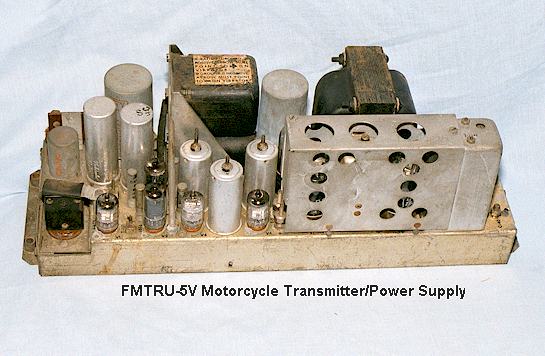
Top view, photo courtesy Scott Cacciamani, Staten Island,
NY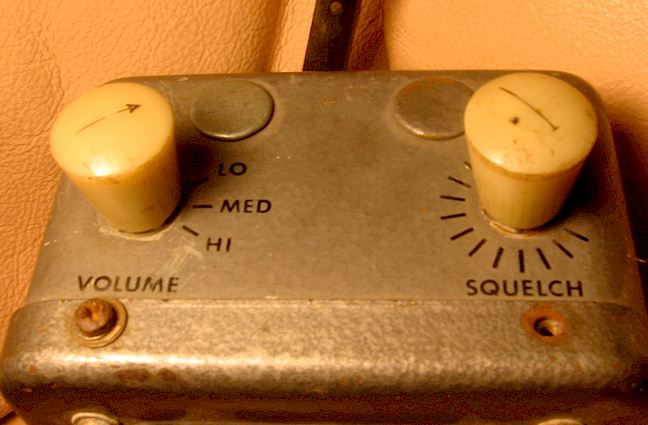
Handlebar clamps:
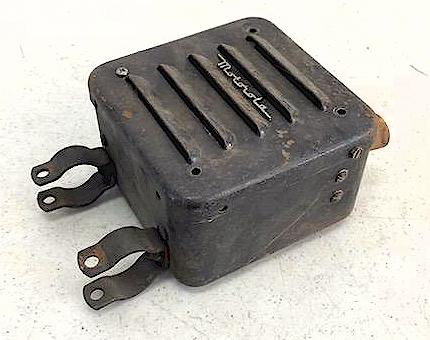
Above photo courtesy James Tate
Shown below is the typical first generation Dispatcher motorcycle microphone, a Shure CB-12 series. Note that the "hang-up" stud is not featured on the rear, as this style microphone was carried in a "claw" type mounting. The discoloration around the push-to-talk button is the remains of the cement which once held a thin rubber membrane designed to keep weather out of the interior of the microphone.
RESEARCH (Unichannel) Series (1951-57)
The original Dispatcher 5V series had quickly become obsolete and by early 1951 was being superseded by the "Research Line" series of radio. The initial Research Line radio was designated FMTRU-41v (M) in VHF high band and FMTR-41V(M) for low band. In appearance it externally appears identical to the FMTRU-5V "Dispatcher" and in fact also was referred to by the same name, except as the "Unichannel Dispatcher" or colloquially as the "41V." Just as the "5V" Dispatcher, the "41V" was also available as a one piece mobile radio. The "41V" motorcycle radio used the same control head as the "5V" model above, and the radio shown in the above photo may be either a "5V" or a "41V" radio as there is no easy way to tell from the exterior.
Technology was moving rapidly in those years and the Unichannel Dispatcher was more advanced and a better radio than the original Dispatcher. The Unichannel contained Motorola's famous "Permakay" filter in its receiver and was more sensitive than the "5V," as in around 0.5 microvolt on 150 MHz while the "5V" would be hard pressed to hear anything less than 1 microvolt. The Unichannel also had separate chassis for each function - - power supply, receiver and transmitter. Unlike its predecessor, the Unichannel Dispatcher also had a deviation control on its transmitter and was capable of meeting the new FCC standards for controlled frequency deviation and stability. The Unichannel series of Research radio was extremely popular and many were made and stayed in service well over ten years. The predecessor Dispatcher was already obsolete and disfavored in less than five.
By approximately 1954 Motorola had begun a modernization of the Research Line which included changing how the model numbers were created, The Unichannel chassis were redesigned to a similar form but lost their name and became known colloquially as the "G" series. The motorcycle radios were initially labeled as the M31-1 and M33-1 series, later re-numbered M31-G and M33-G, still using the same sort of saddlebag-style black steel box housings. All chassis were separate units in the Research model, so in Solocycle applications one saddlebag box held the transmitter and power supply, while the other contained the receiver only. This Research Line motorcycle radio was also made in a one-piece case as a Servicar radio for three-wheeled cycles, as its predecessor, and the control head for the Servicar was a flat faced box which mounted through a large hole in the rear box of the three-wheeled cycle, facing the rider's left side from behind. See photos below. The Research Series was replaced in approximately late 1955 with the "Twin-V" equipment, which was largely a change in name only. . The Twin-V name referred to the car type radios which were marketed to deal with the American auto industry's change-over to 12 Volts, being capable of functioning on either 6 or 12 Volts depending upon the cables used. Motorcycles remained 6 Volt until well into the 1960's, so the Twin-V name was somewhat of a misnomer when applied to that equipment. Some of the Research Line mobiles also offered this feature, so it wasn't anything new with the Twin-V series. The Twin-V series is almost identical to the Research, except for new control head and microphone styles as seen below in the Twin-V section.
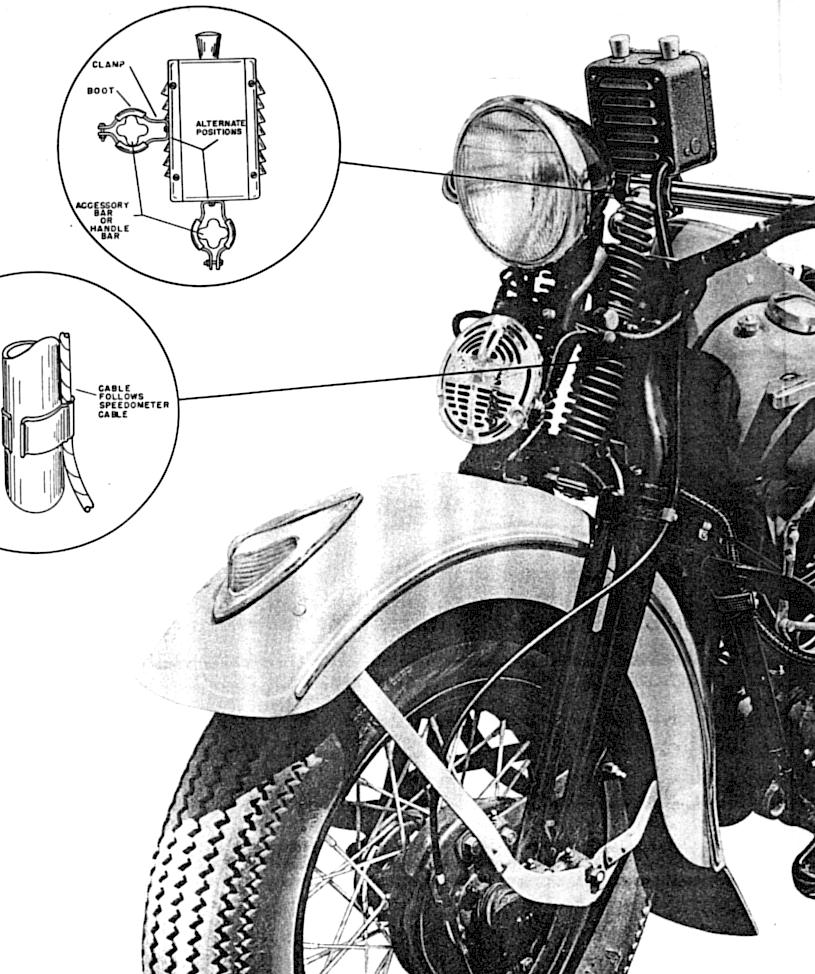
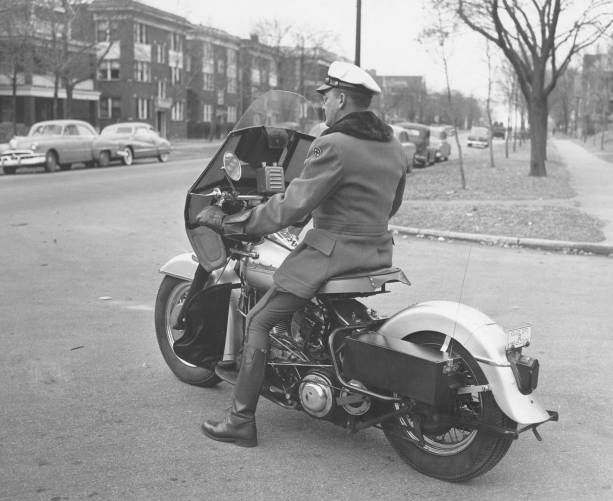
Note in the photo below that the microphone is
held in a bracket at the fuel tank, and that the microphone connector is at the
end of a cable on a small bracket.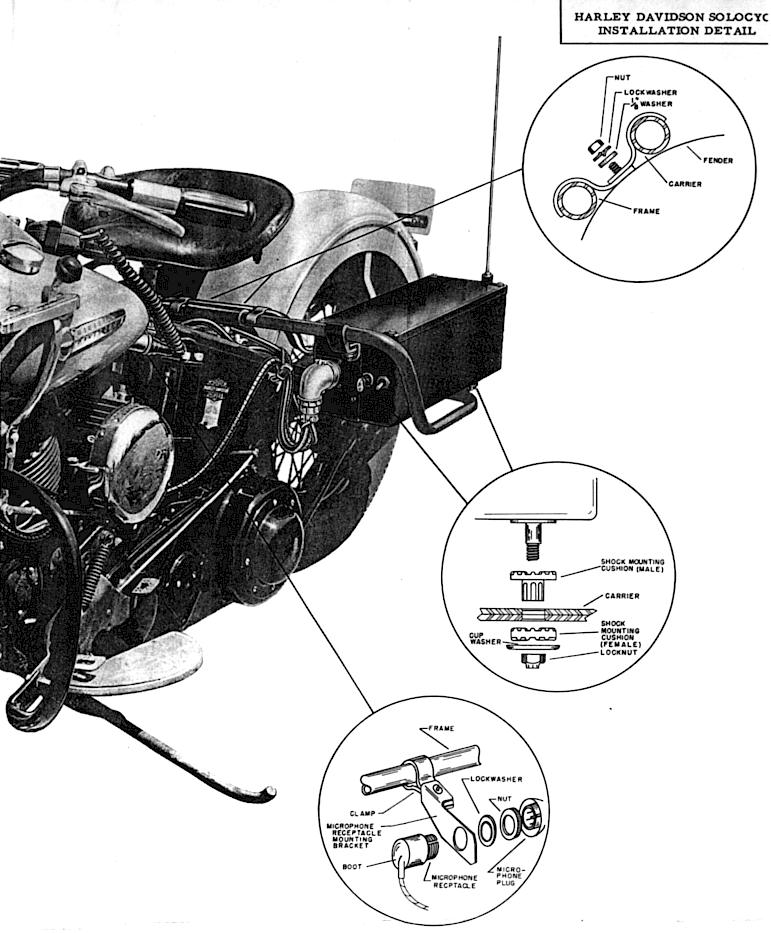
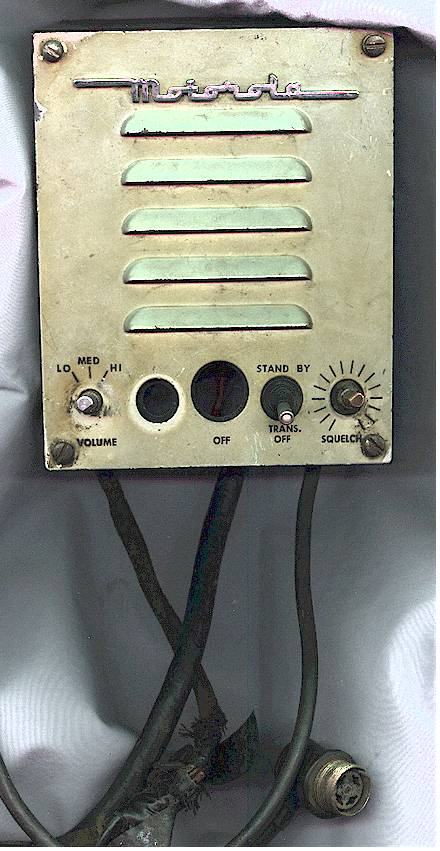
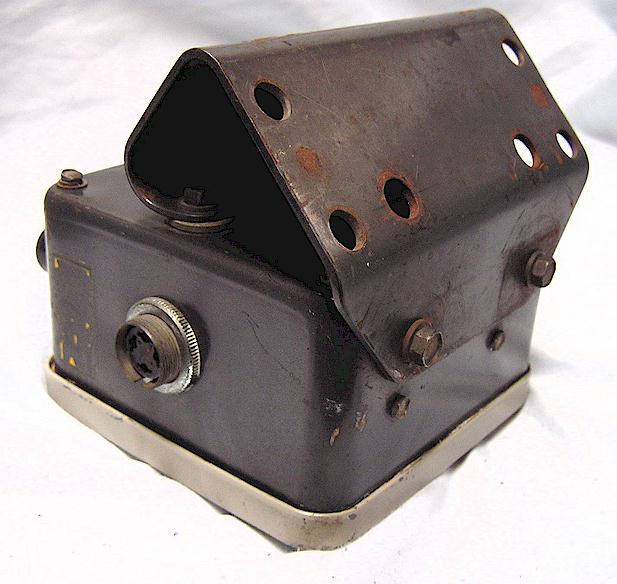
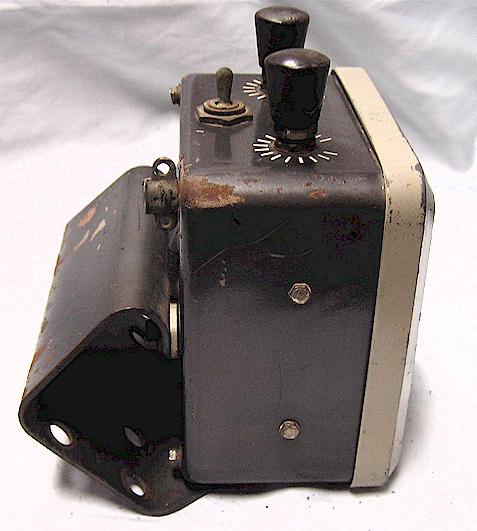
Shown below is a rather shabby Servicar head. Note that the knobs are missing as is the key switch. The hole next to the volume control would have been covered with a plug and would have contained the rare two frequency switch where used. The larger hole contained a key switch similar to a Briggs & Stratton ignition switch. This head was used on both the FMTRU-5V and the Research S31-1 and S33-1 Servicar sets. This head mounted on the left forward side of the rear box of the three-wheeler, the microphone hanging on the side of the fuel tank.
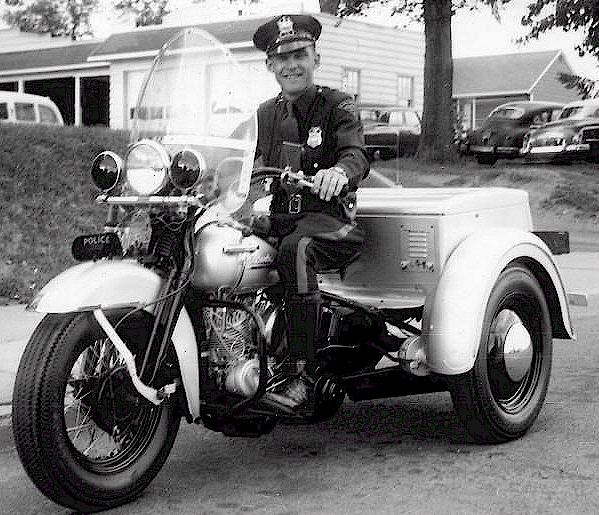
Shown below is this head mounted on a Servicar, taken in 1954. Note that the Servicar radio package was physically identical to the automobile mount radio version, not two-piece as the Solocycle was.
TWIN-V Series (1955-1960)
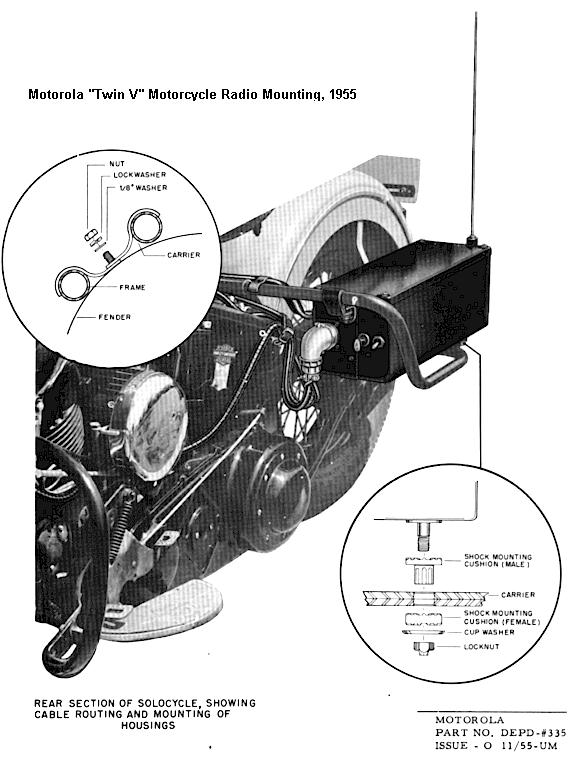
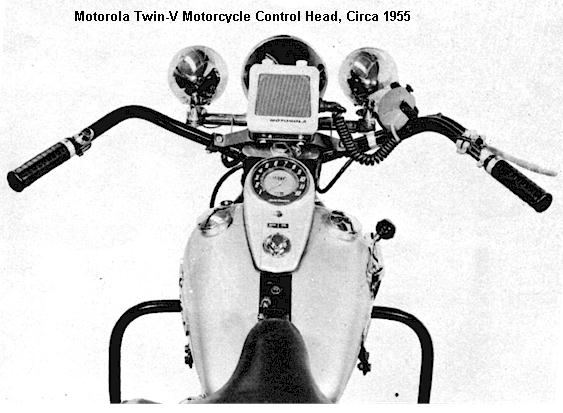
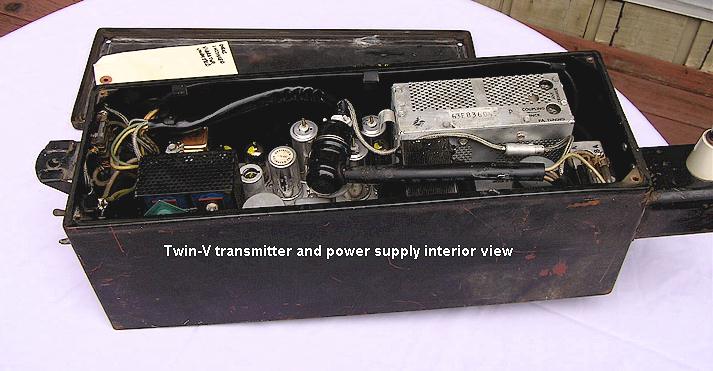
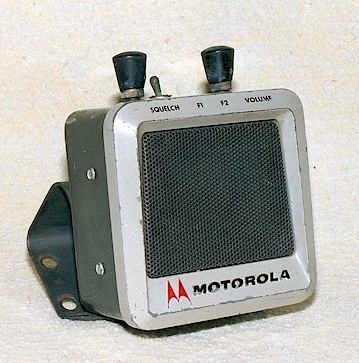
As mentioned above, the "Twin-V" was a slightly upgraded replacement for the Research Line but basically the same radio. The Twin-V, like the Research sets, was offered in a two-piece saddlebag mounting scheme (models M31GGV and M33GGV) and also as a one-piece Servicar unit (such as the S31GGV-1100 series radios.) The Twin-V used a new style control head, still basically a mobile speaker housing, but now matching the Twin-V car radio speaker design, with two-tone paint.
The Twin-V, as its predecessors, was not well liked by the end users because a motorcycle battery is relatively small and cannot cope with the current drain of what was essentially a car style mobile radio of all vacuum tube construction. Now as a motorcycle generat9or up to the task. When the new hybrid "Transistorized Dispatcher" equipment was released in early 1958, it quickly became enormously popular with police motorcycle users because of its light loads on the motorcycle battery system and the ability to be left on for longer periods without draining the battery dead, and officers would squabble over who would get the motorcycles with the new hybrid radios versus the older Twin-V.
The control head was part number TU-346 for single frequency use and TU-346-C(2) for the two-frequency model. Note that the photo of the microphone from the manual shows a "smooth rear" first generation wrinkle finish microphone as found on the Research and "Dispatcher" motorcycle radios, rather than the mobile style with a hang-up stud button on the rear. It is possible a "Twin-V" style mobile microphone was actually shipped with these, and whether or not it had a rear "hang up" button is unknown at the moment.. Note also that the knobs were supplied in either black or white. The white knobs prevailed throughout motorcycle radio production to the end of the hybrid radios (Transistorized Dispatcher) in 1966. the example head below with black knobs was originally shipped to the California Highway Patrol. They were fond of specifying some often trivial change to equipment they used, including cars, guns, sirens etc. such that these items would then be referred to as "special for California Highway Patrol." Thus they may have requested black knobs for some strange reason. they have not been seen on control heads used by any other agency. These knobs on the control head below also have tension nuts below them which allow a somewhat crude method of locking the knobs in place or at least tensioning them such that they do not move under vibration. the F1-F2 channel selector switch was originally fitted with a thin rubber weather boot over the handle, but typically, these have rotted away over the decades and seem to have never been replaced by the agency shops that used them.
The microphone continued to be mounted separately. There is no microphone hang-up clip on the left side of the head, which is smooth, and the cable exit is on the rear. Unlike the FMTRU-5V and Research Line radios, the Twin-V series used the same handlebar-mounted control head for either the Solocycle or the Servicar sets. The Twin-V name was actually applicable to the car type mobile radios, which were called that to capitalize on the feature of being able to be used on either 6 or 12 Volt vehicles by selection of the appropriate cable (even though "Research" car mobiles could also be ordered as 6/12 V capable.) Motorcycles remained 6 Volt until into the 1960's. The circuitry of the Twin-V chassis is almost the same as that of the Research Line shown above, other than some component improvements. The Twin-V was the last all-vacuum-tube motorcycle radio by Motorola, as well as the last one using a vibrator type power supply. Motorola continued to use the name "Research Line" well into the 1960's, so the use of the term "Twin-V" here is a bit confusing. I refer to the last generation vacuum tube radio as the "Twin-V" because the manual for it refers to it as such.
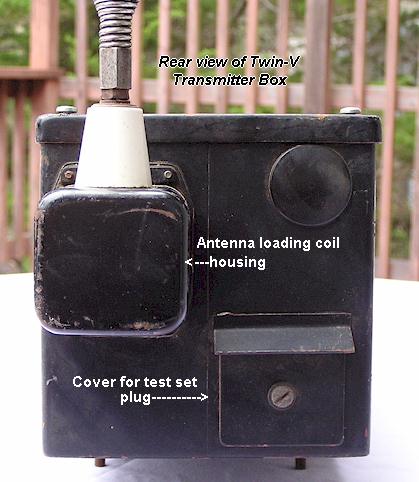
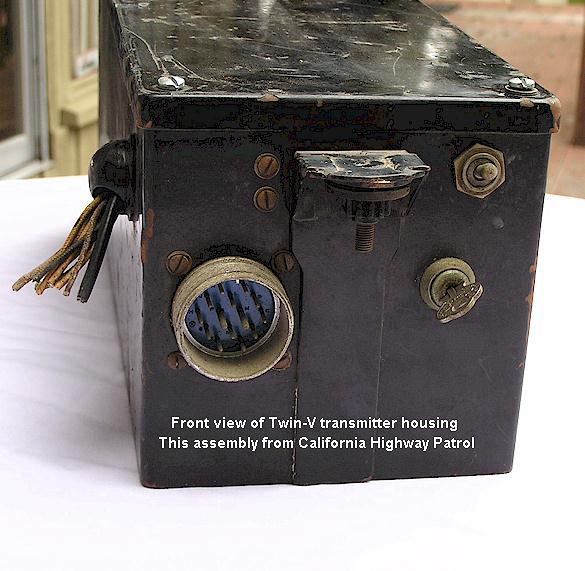
Note that the radio shown mounted in the photo below is actually a Research series, used in the Twin-V manual because the two are so similar, apparently to cut photo costs in production of a manual and to speed up the printing process at the "bindery." The Twin-V toggle switch for "standby-operate" is in a different place on the Twin-V, see the photo of the California Highway Patrol Twin-V box below for an example of this. The microphone shown may also be an earlier Research style which, in production, may have been a "Twin-V" two-tine paint scheme.
The high band (150 MHz) Twin-V boxes do not have the bulge on the rear featured on the low band (30-50 MHz) radios, which houses the antenna loading coil assembly.
MYSTERY RADIO: The radio shown below is a mystery set. Note the bizarre antenna, called a "DDRR" in the industry (directional discontinuity ring radiator.) The motorcycle was an in-service Anaheim Police (California) unit in 1966. The control head appears to be a Twin-V style head because of the separate mike hang-up arrangement, color scheme and cable exit out the back, but the radio is a one-piece unit mounted in what appears to be a steel box above the rear fender, where the antenna is mounted. This radio was made by Motorola for cities in Orange County, California. The antenna, not a Motorola item, was apparently produced locally by a Los Angeles area manufacturer. Anecdotal evidence suggests that possibly the Twin-V radio may have been available in a one-piece over-the-fender style box, on special order, which would explain this oddity (except for the antenna.) Any information about this strange set would be appreciated!
Photo courtesy Ray Grimes, Orange County
Sheriff's Communications 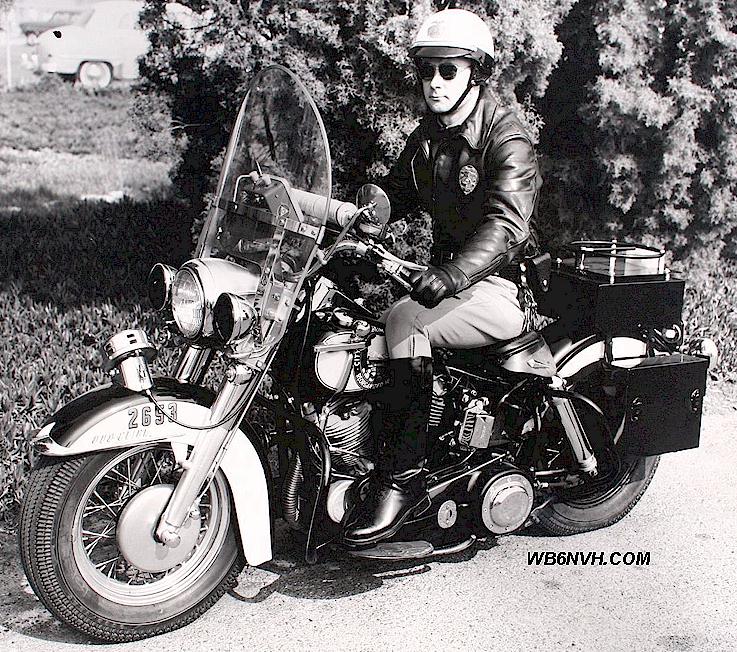
Ver. 07/15/2024 © Geoffrey C. Fors 2006 All rights reserved