MYSTERY RADIO GEAR

This page shows photos of equipment in my collection which either I am unable to identify or locate documentation for, or both.  If you recognize any of these items, please contact me!


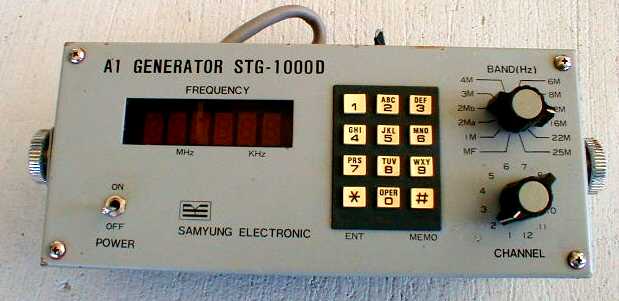
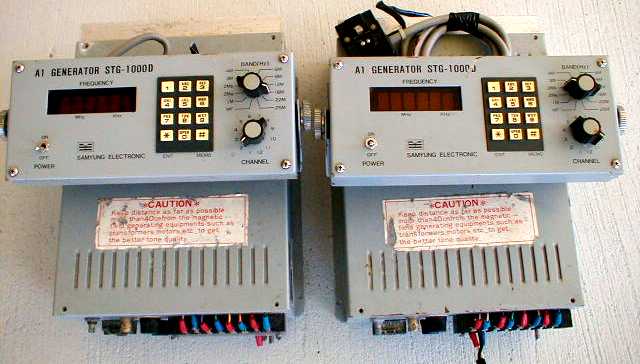
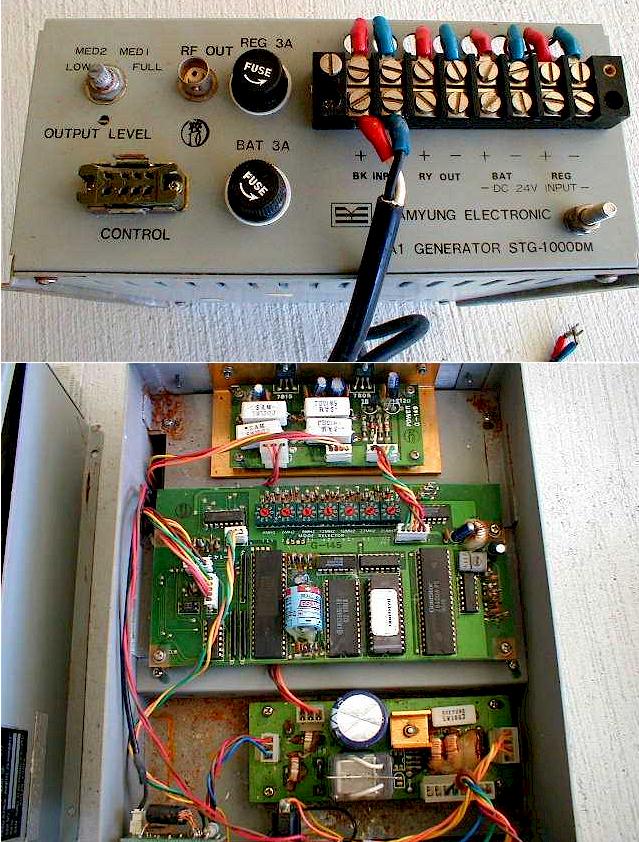
SAMYUNG ELECTRONIC A1 GENERATOR

I have two of these which were removed from a Korean fishing ship about 10 years ago.  They appear to be some sort of transmitter.  The control head has the capability of entering in a frequency on any of the HF maritime frequency ranges via the keypad.  There is a connection for a 24 Volt battery power supply and also a main power supply.

Samyung Electronic, a Korean firm,  still exists and has a rather odd website which makes a brief mention of these items as part of their biography, without further explanation.  An e-mail to them brought no reply.  A Samyung website in 2003 makes mention of an "A1A Frequency Generator" described as "Communication Equipment" for the "supporting organization" of the Korean National Fisheries Research and Development Institute.  Thus, I am wondering if these are some sort of drift-net buoy beacon transmitter?  If you know, please share!


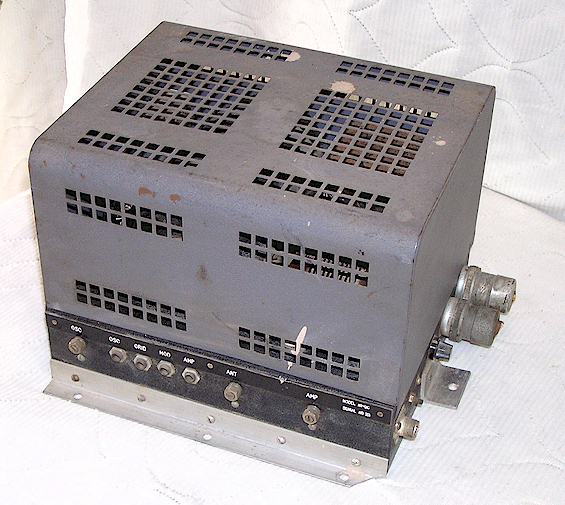
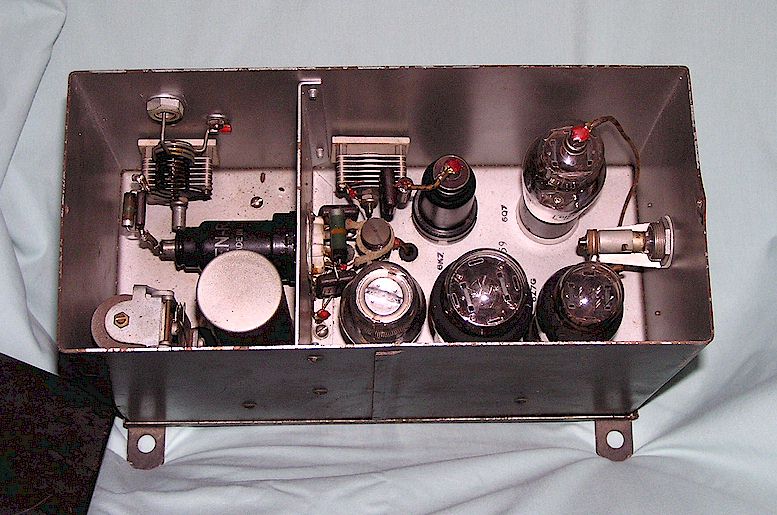
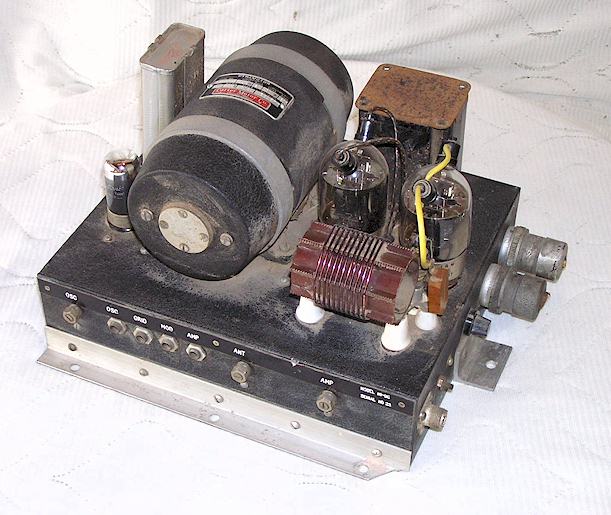
"N1-DC" MOBILE AM TRANSMITTER

This is a mystery 12 Volt DC powered AM transmitter, which turned up at the Livermore, California electronic swap meet some years ago.  It uses an 815 PA tube modulated by a second 815 used in push-pull, with a 14C5 as oscillator.  There is a 5912.5 KHz crystal in it.  There is no maker's name but there is an engraved plastic placard which includes the words "Model N1-DC" and "Serial No. 23."  It appears similar to Temco mobile equipment made for the U.S. Border Patrol immediately after WWII.  The brackets on the sides of the chassis appear home made and probably date later than the transmitter.  Can you identify this set?

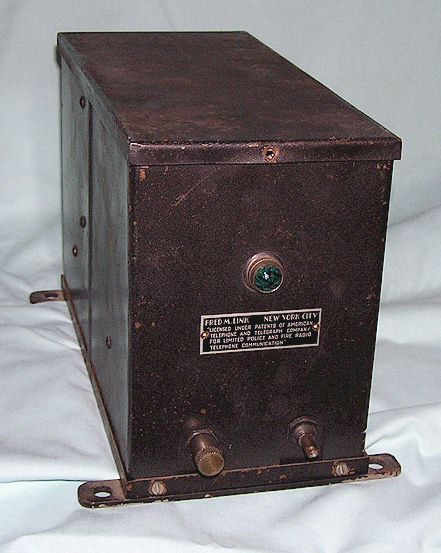
FRED M. LINK "UHF" RADIO RECEIVER

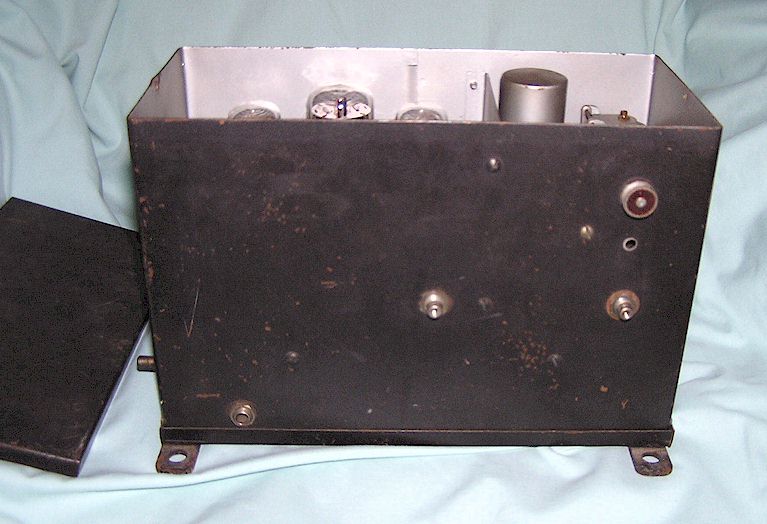
Here is a VHF super-regenerative (apparently) police radio receiver made by the Fred M. Link Company in New York City probably about 1936-37.  Link is well known, but this receiver has no model number on the nameplate and may be an experimental model.  The power supply was a separate item, probably a dynamotor or pack of "B" batteries. I suspect the antenna connector is not original.  If you can identify the model and year, please contact me!


HULL 924 HF SSB Marine Transceiver

The Hull Electronics 924 in a synthesized marine HF SSB transceiver which operates primarily as a USB radio, running about 150 Watts PEP output.  It's not a mystery radio, but Hull has been out of business for some time and the documentation seems to be very hard to find.  I am looking for the service manual for this radio in order to get it on the 60 Meter amateur band. 


DENTRON SCOUT HF SSB UTILITY RADIO

A candidate for "most obscure HF radio of the 1970's" is the Dentron Scout, a five channel utility radio which apparently covers approximately  2-10 MHz, upper sideband only.  This was one of Dentron's last products before the company went out of business.  The main chassis of this set turns out to be the Mizuho SG-9 9 MHz IF-exciter system, coupled to a Dentron crystal controlled oscillator-front end board and a Dentron high power RF amplifier. Other than knowing that the main circuitry is Mizuho (apparently equally hard to source data for,) I have no data.  I can tell you which pot adjusts the s-meter, but that's about it.  Most or all of these sets seem to have been employed on Civil Air Patrol channels in the 4.5 MHz range.  Mine puts out approximately 125 Watts PEP. 

Dentron also used the Mizuho board in a QRP single-band transceiver they had in beta testing when the firm folded.  The remains of that inventory have been sold and rebuilt into usable transceivers by enterprising amateurs in England and the USA.   The Scout would seem an ideal candidate for the 60 Meter amateur channel group, but...what happened to the RIT control?  A very necessary item, strangely overlooked in this set.  Let me know if you have one of these also.  By the way, the mike is a simple 500 Ohm dynamic CB style item, with the ground going to the barrel, microphone hi to the sleeve and PTT to the tip of a 1/4 inch stereo plug.  One of the junkbox mikes I tried had a 1K resistor in series with the microphone element, but I left it in place and the mike sounds fine.

The photo below shows the Scout with the accessory HF-ACS regulated power supply, which, curiously, includes a speaker identical to that already inside the Scout.  Perhaps the power supply was also sold for use with another model which did not feature an internal speaker. 


LAND-AIR Inc. Low Band Pack Set

This is a VHF FM 40 MHz pack set radio made by Land-Air Corporation in the 1950's.  It uses wire lead subminiature tubes and a pile of dry "B" and "A" batteries.  Land-Air seems to have been a contractor for the United States Air Force which maintained military planes on US military bases around the world.  Why they would go to the trouble of building their own radios, escapes me.  It's much larger than contemporary pack sets by Motorola or Industrial Radio.  Do you know anything about this radio?


FREDERICK ELECTRONICS MD-1130 RTTY TERMINAL

Frederick Electronics was a long-time maker of specialized RTTY equipment for the government.  During the time this item was manufactured, they were part of Plantronics, Inc.  This particular item appears to be four each of a  version of the Plantronics Frederick 1280 RTTY terminal built into a large cabinet.  It was obviously part of a larger system and showed up as surplus in San Diego, California, via the DRMO - Government Liquidation system.  Looking for any documentation or identification of this item!


SWEDISH SRA STATIONSENHET R-70 

This is not exactly a mystery radio, it is known to be a Swedish civil defense FM transceiver which operates in the 68-80 MHz range with 320 channels. The 75 MHz aircraft marker beacon frequencies are skipped.  The transmitter output is a nominal 10 watts and the receiver has a rather dismal 0.6 microvolt sensitivity for 12db SINAD.  They were generally stored in civil defense caches at local fire departments.  It is synthesized, and originally was supplied with a large portable antenna stored in a canvas bag about the size of a golf bag.  SRA was a large communications equipment manufacturer in Sweden which no longer exists, having been absorbed by Ericsson some time in the late 1980's or early 1990's.  A moderate quantity of these and their antennas were imported by someone in the late 1990's, and at least one surplus dealer, Sportsman's Guide Co., was offering the radios and the antennas as separate items.  It is presumed that the majority of the antennas were bought by radio amateurs for the parts value, since 68-80 MHz is not an amateur or a vehicular land mobile allocation in the USA.  This example is not from that source but it is presumed to be identical to the others.  This unit appears to date from the late 1960's and contains a transistorized power supply, which can be heard whining during operation.  I have been unable to remove the gasketed outer cover without injury to the case, however it is presumed that the radio is partially transistorized.  The rather peculiar method of channel selection is somewhat of a mystery.  The handset is a nice, rubberized folding item similar to the NATO H-189 handsets.  The control head is reminiscent of the RCA 700 Series radios of the 1970's. There was also a separate AC power supply made.  the antenna connector is, oddly, a "C" connector, not exactly common in the USA. I have some .pdf and Word file pages of documentation on this set (in Swedish) if you are interested.


KACHINA ORPHAN LOW BAND MILITARY HT

Another not-really-a-mystery radio, this is a brand new 1990's Kachina Communications 66-88 MHz hand-held FM transceiver made for military sales.  Kachina went out of the radio business some years ago, making this an orphan.  I have been unable to find out any data on it.  16 channels, hi-lo power, scan and (apparently) a CTCSS function.  Built stronger than a brick in an anodized aluminum case.


KACHINA KC 100 HF SSB TRANSCEIVER

Yet another not-really-a-mystery item is the Kachina KC 100,  a high frequency SSB transceiver which I have been told is similar to the ALDA 103 amateur radio.  It puts out about 150 Watts PEP.  Most of these seem to have been utilized by the Civil Air Patrol.  Evidently there was an optional provision for AM and LSB, although all of these I have ever seen have been USB with a plug button in the mode switch hole as shown in the photo below.  I am looking for documentation on this transceiver.  Kachina exited the radio communications business about 2003 and are no longer supporting this item.


THE STRANGE CASE OF THE DAX RECEIVER

Truly a mystery is this receiver I rescued from an estate load at the old "Foothill" electronics flea market when it was briefly held in the Lockheed parking lot in Sunnyvale in September, 2004.  The DAX was a rather obscure mobile naval DF receiver from the 1944 era, however this one appears to have possibly been a factory prototype,  The front panel is rather crude with letting done in pencil.   The chassis is obviously hand made, but with a high degree of precision which would seem unavailable to a home constructor.  There are complex castings which would have had to have been made in a manufacturing plant.  The wiring quality ranges from the superb to rather crude, perhaps representing successive work on the set.  The receiver is an AC-DC transformerless design.  I have it in functional condition, however a number of aspects leave a lot to be desired.  There is no BFO, and the tuning on the uppermost band is too fast and the stations too crowded together.  The set has no AGC.  The lowest band can be driven into overload by strong signals.  The antenna connection is via the rare "twin" SO-239-style connector.  The empty hole next to it was possibly for a "sense" antenna.  I am looking for a DAX manual to compare circuitry.  Let me know if you have one!

So...what was this?  A design prototype?  A damaged DAX which was completed by some ham?  A homebrew job made with leftover parts from the DAX production line?  The answer may remain a mystery...


BDM SCI IV

This appears to be some sort of modem for use with late model military cipher equipment.  Any ID or data appreciated!  


US FOREST SERVICE KU-R MEDIUM FREQUENCY RECEIVER

This was found at an electronics flea market in June 2009.  No longer a mystery as of October, 2009, it was previously listed here as such and thought to have been a 1.7-2.5 MHz mobile police set. Thanks to Craig Leventhal, N3TPM, it has been identified as a Northern Radio Seattle Type KU-R Model A mobile receiver, made for the U.S. Forest Service probably around 1944.  The main radio "box" is in fact only an IF strip and audio amplifier; the RF stages, tunable oscillator and mixer are inside the control head (!) and the RF signal is piped to this unit via a cable.  Northern Radio was a Seattle, Washington manufacturer of marine and tactical radio equipment which is primarily known for its marine radios made in the 1970's, although they, along with Spokane Radio and Radio Specialty Mfg. made a number of sets for the United States Forest Service during the war years of 1940-45.  The U.S. Forest Service designed most of its radio equipment in-house during these early years and some of it is a bit bizarre in appearance.  In general, all USFS equipment prior to the conversion to VHF FM in the early 1950's is rare and was made in relatively small quantities.

The Cinch barrier-terminal strip on the example below appears to have been added later by someone, replacing the original, as was the external audio output transformer stuck on the exterior (evidently the original was defective.)  There is a metal cage on top containing two power resistors to drop the input voltage, in this case from 12 Volts to 6, the original primary input power.  The old auto-radio style bayonet fitting is not the antenna input, as I originally believed, but actually the IF signal input from the control head.

Photos below show the original control head, courtesy Craig Leventhal, N3TPM


"WRONG" BIRD STYLE RF WATTMETER ELEMENTS

What's wrong with the wattmeter elements below?  They are made for a full scale reading which doesn't exist on off the shelf Bird, Sola Dielectric or Coaxial Dynamics RF watt meters!  What are these for, and why?  The Coaxial Dynamics element is from the FAA and I think the red one may have been also.  I think there were some wattmeters with a 12.5/ 2.5/25/60 Watt scale, with a larger plastic faced meter, which these apparently went with.  But why?  None of the red-faced elements ever seem to have a standard scale and all seem to be for this mystery wattmeter.  I have an FAA surplus Sola Dielectric wattmeter, but it uses the same scale as a standard Bird 43, and can't use these either!


BACK TO HOME PAGE


Contact me:  geoff @wb6nvh.com       

Ver. 1/03/10