UNUSUAL
POLICE, FIRE AND HIGHWAY PATROL SPECIAL PRODUCTION 2-WAY RADIOS
This page is an adjunct to my pages on the California Highway Patrol radio system and consists of assorted miscellaneous photos of radios used by the police and highway patrols of other states and countries in various years, in no particular order, as well as larger fire agencies and federal government groups. If you have photos of unusual radio equipment used by any state highway patrol or police or fire agency, I would be happy to add them here and give you credit. I have avoided showing common, off-the-shelf models of equipment. This page only shows unusual or specially made equipment.
RCA Equipment
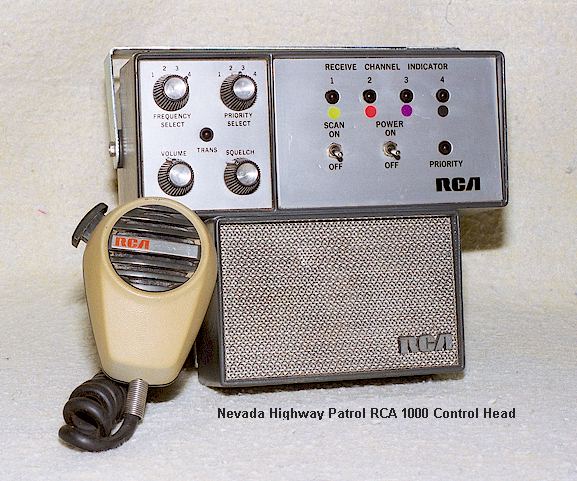
RCA 1000 Series, 42 MHz, Nevada Highway Patrol + Michigan State Police, Mid-1970's
NHP used these along with an assortment of conventional, non-scanning RCA 700 Series mobiles, in the mid to late 1970's, perhaps up into the 1980's, on a 42 MHz low band system. They seem to have also used a wide assortment of other gear by Motorola and possibly GE during this time. This same RCA 1000 head and drawer was also used by the Michigan State Police during the same time frame.
GE Equipment
GE MASTR PROFESSIONAL
California Division of
Forestry Photo courtesy of Bob Thompson
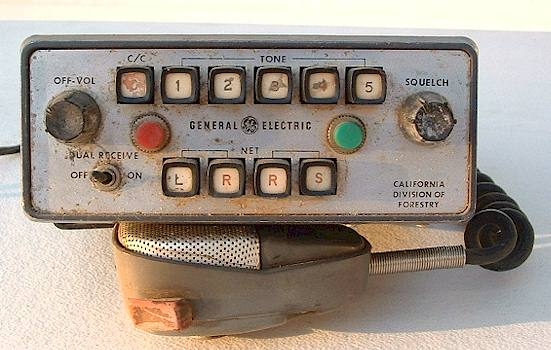
GE Mastr II WASHINGTON STATE PATROL 1977 (?)
Equipment used large cased "E" series VHF High
Band radio drawer. Dual receive.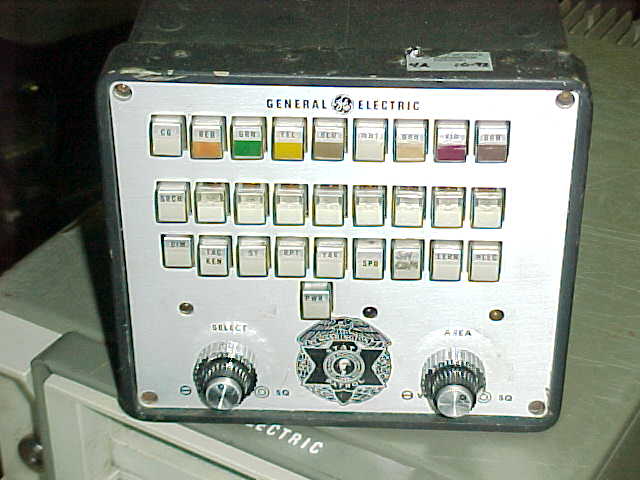
California Division of Forestry GE Mastr II Head
Photo courtesy of Bob Thompson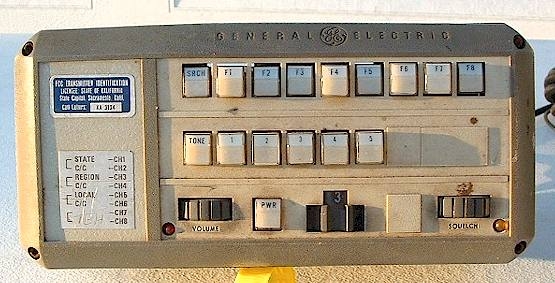
Motorola Equipment
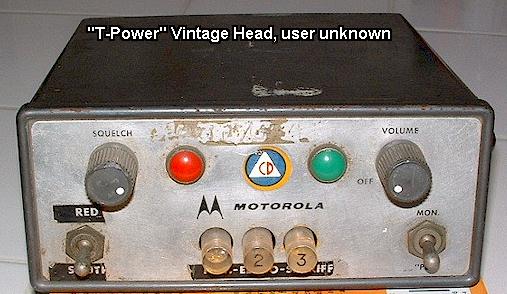
Head below believed to be early California Division of Forestry, for a Twin-V or "T-Power" mobile radio drawer: Photo courtesy Bob Thompson
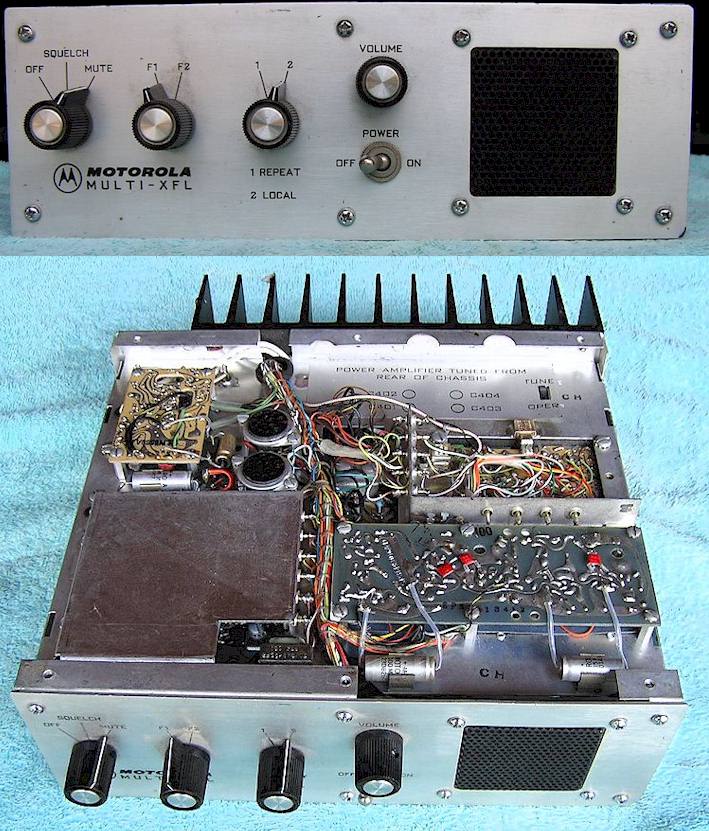
Motorola Multi-XFL VHF High Band Repeater. This example was a federal government order for Bureau of ATF, circa 1970.. Uses HT-200 circuit boards, 166 MHz range. Type of outer housing unknown. The Multi XFL was made in VHF and UHF models, and in 5 and 15 Watt versions for VHF. They were purchased as forestry lookout equipment, law enforcement special application gear, and by United Airlines as ramp equipment, among others. Oddly, the Multi XFL never received a Motorola production model number and was always a Special Products Division item. Some model numbers were:
SP 3149901 - VHF 15 Watts SP3149902 - VHF 5 Watts SP3149903 - UHF 5 Watts
MOTOROLA MOTRAC, MOTRAN, MOCOM 70
Special production control heads and radio drawers seemed to have proliferated in the 1960's for Motorola's Motrac model equipment. Here are just a few. California Highway Patrol special control heads and radios are separately shown on my main CHP Radio page.
California Division of Forestry, 1969. QCN1019A.
Photo courtesy Bob Thompson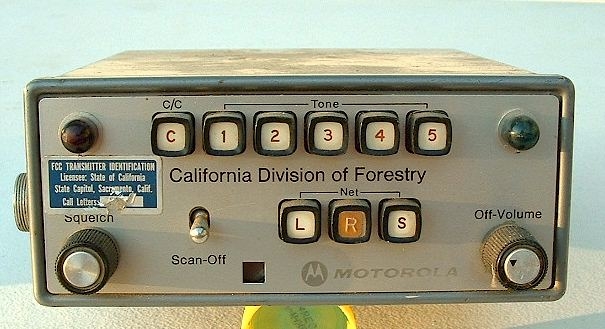
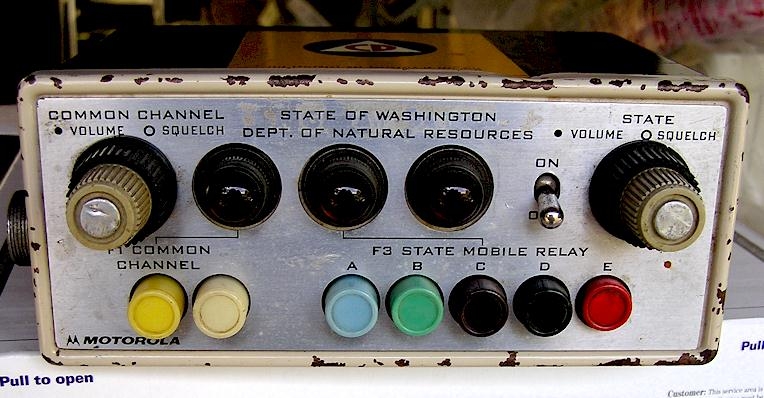
Washington State Dept. of Natural Resources - Dual radio control head. 1963? Rear panel has a male connector as used on mobile telephones of the era, rather than a pin-socket panel as regular Motrac heads.
WASHINGTON State Patrol - Notice that this head is almost the same as the Dept. of Natural Resources head above other than saying State Patrol and having different pushbuttons and dimmable lamp lenses. These heads were replaced by the GE MASTR II State Patrol heads shown above.
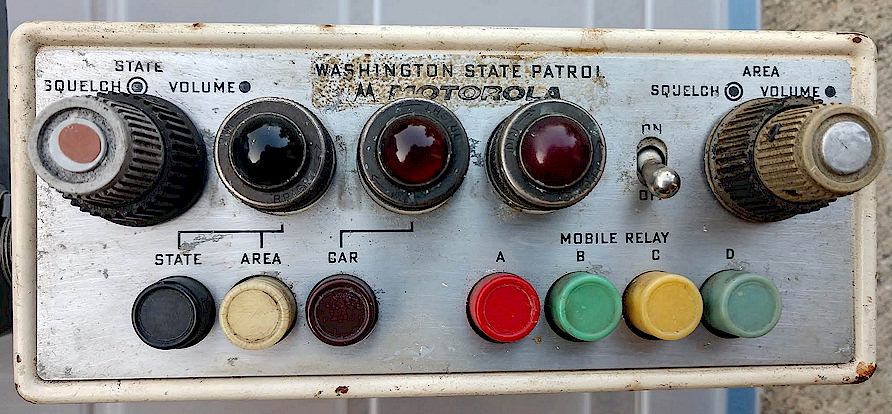
Photo courtesy James Tate
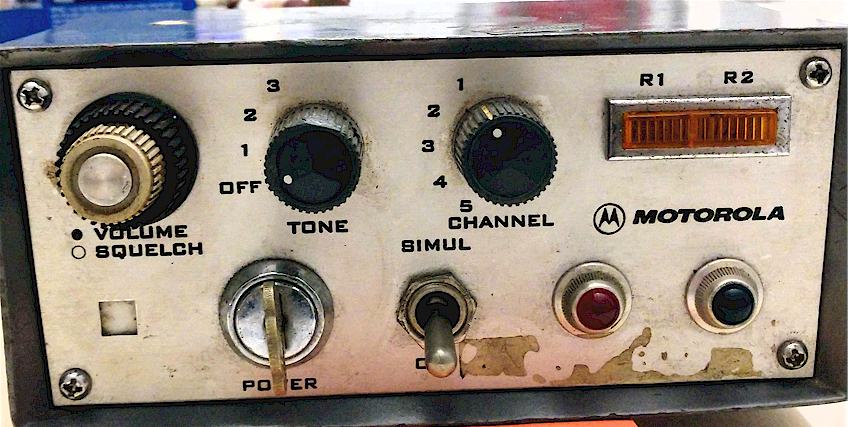
Motrac Unknown User - This head is dated 1967 and comes from an unknown user, but it must have been a large system. One comment was that it was from a large transit bus network. Thanks to James Tate for the photo.
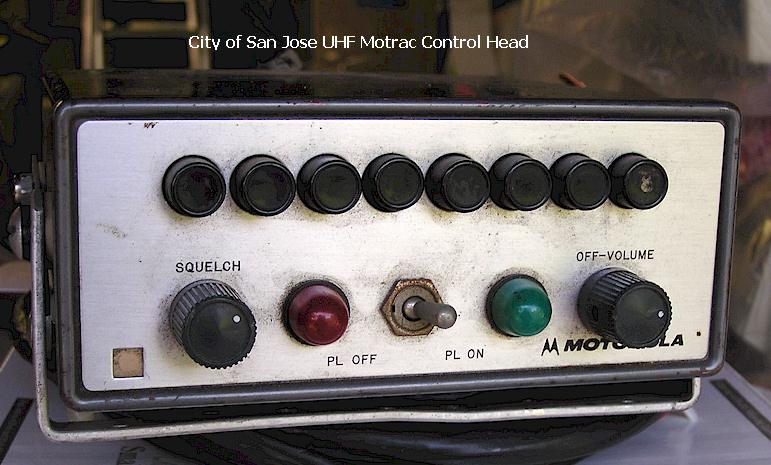
San Jose, California Police Motrac- UHF Radio. 8 channel with multiple PL tone capability, circa 1969. If it weren't for the date marked on this head by the factory, and that I have the matching UHF Motrac radio drawer, I would swear it was a 1960-62 era head for a special T-Power radio, by its appearance! PL reeds located inside head. There were several cosmetic variations of this head, a later version was in a "driftwood" color cast housing with larger square colored pushbuttons that were apparently illuminated.
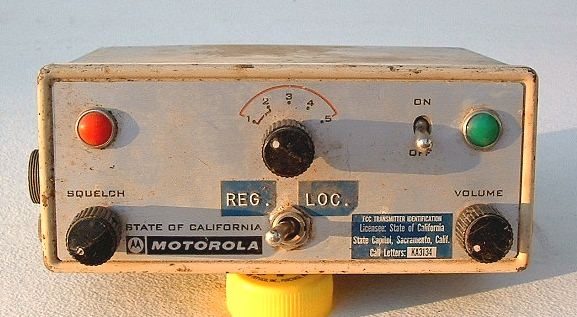
California Division of Forestry, 1963 XCN6892AK SP 3 Photo courtesy of Bob Thompson
North Carolina State Highway Patrol. Very heavy die cast housing.
Used with T71LHT 42 MHz Motrac.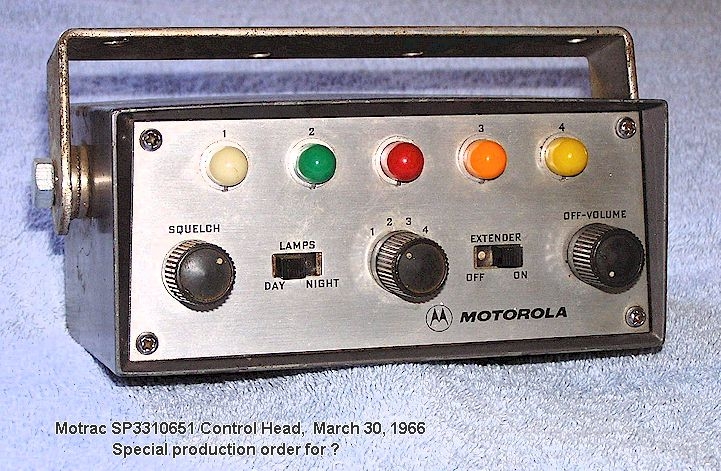
The above head has been identified as matching a low band 100W Motrac, type T71LHT, purchased approximately 1966 by the North Carolina State Highway Patrol in a relatively small quantity of approximately 200 units, as a replacement for some of the fleet of 1950's T51GGV series Twin-V mobiles. These were in turn gradually replaced by GE MASTR Professional radios by the mid 1970's.
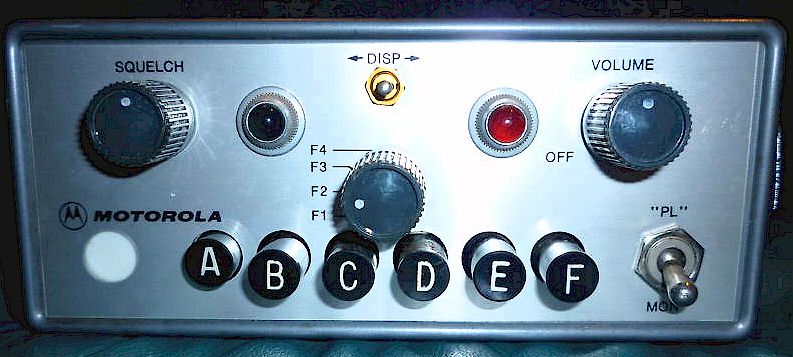
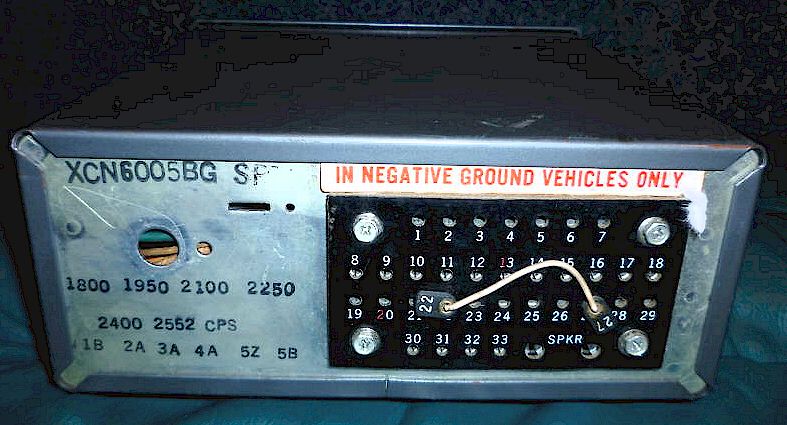
MOTRAC 1966-1969 HEAD, USER UNKNOWN
This is an XCN6005BG SP-? series head. The original user is unknown, but the head appears to have been used with either a high band or UHF Motrac series mobile which had four channels and a choice of PL tones (the pushbuttons) and/or single-tone bursts. The view of the rear panel appears to have a hole where a rotary switch was installed, perhaps to pre-set the tone burst frequency. This head turned up on eBay in July, 2010 without any other pieces. It is unknown what the "Disp" switch accomplishes. The description indicated sockets for six PL encode reeds inside. The white disc under the Motorola logo is a light sensing window for a photocell which dims the pilot lamps at night automatically. The 2552 Hz tone burst frequency is believed to have only been used by the State of California, so possibly this head was supplied to some state agency there.
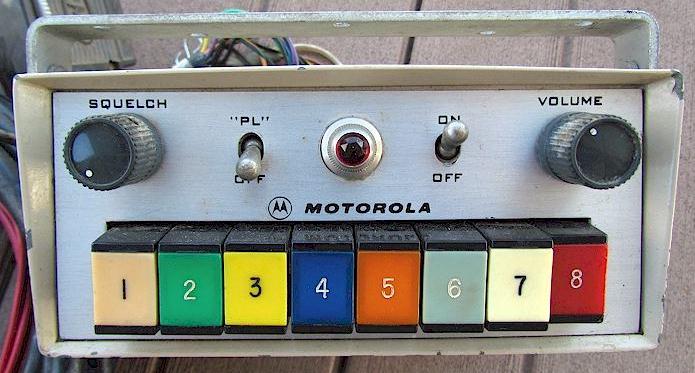
8 FREQUENCY MOTRAC HEAD, SAN JOSE CA. POLICE UHF SYSTEM
This example showed up on eBay in September, 2012 from an estate in Bronx, NY. I have been informed that these were used by the San Jose, California Police Department in the 1970-80's era on their UHF system and are a later example of the other San Jose Police head shown above on this page. It is possible they were also used by other agencies and may not have been unique to San Jose.
North Carolina Highway Patrol Motran, 1967
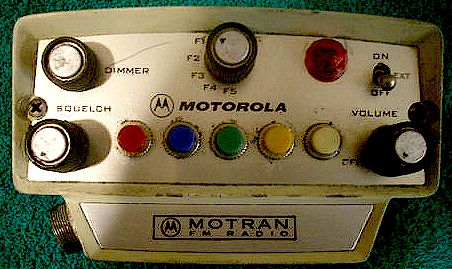
This was another variation of North Carolina Highway Patrol equipment heads.
Unknown User Motrac Head
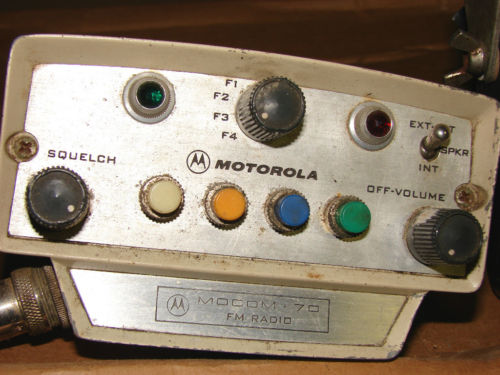
This appears quite similar to the Illinois State Police Emergency Radio Network head, circa 1970, shown below, but isn't.
ISPERN CONTROL HEADS
Shown below are Motorola and GE examples of Illinois State Police Emergency Radio Network control heads. These were installed to allow statewide communications between related police agencies and were a supplemental radio in addition to the normal sheriff or police network radio. These date from approximately 1970. Note the special red microphone.
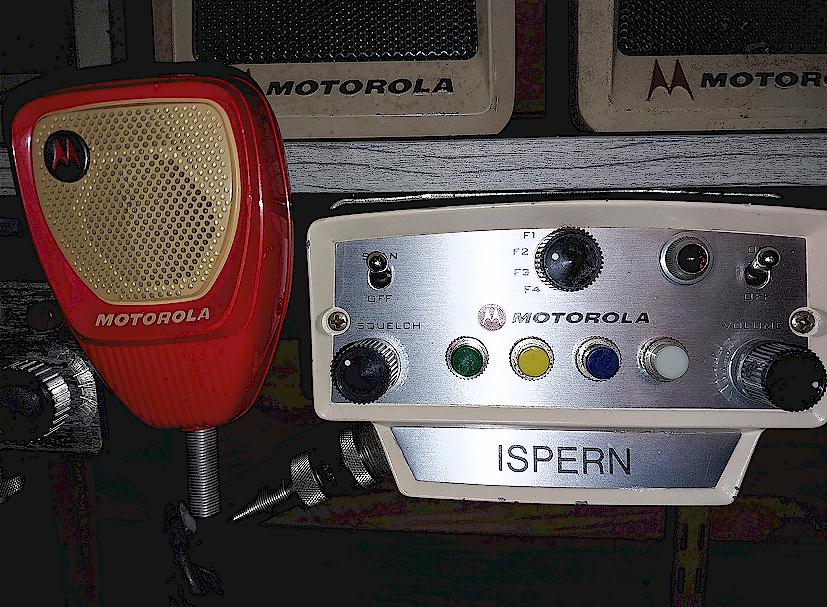
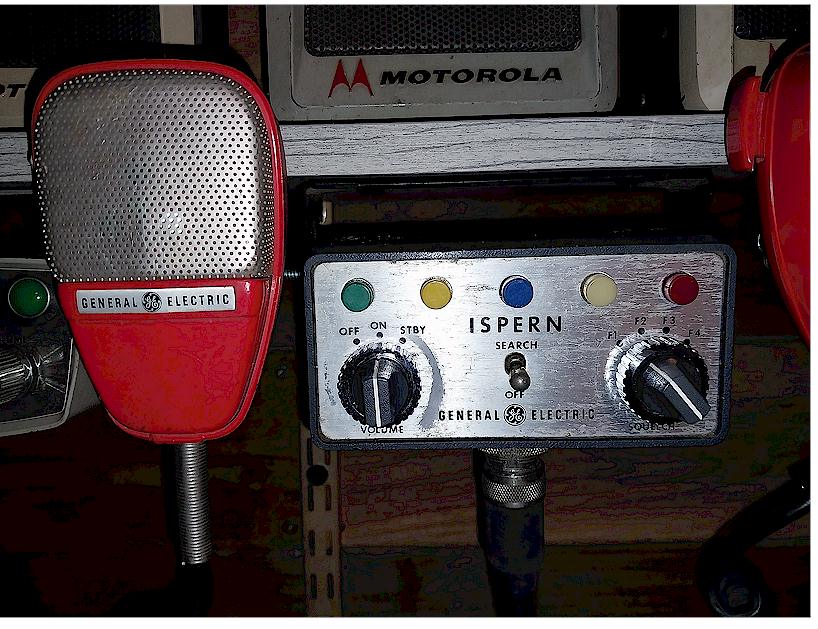
Thanks to Richard Paul for these photos!
Ver. 08/19/2025 © Geoffrey Fors, 2007 All rights reserved